
Architecture, engineering, and construction (AEC) firms are locked in a high-stakes balancing act. Public infrastructure pipelines and specialized data center demands require unprecedented capacity. Concurrently, profit margins are squeezed tightly around a brutal 5% industry benchmark, exacerbated by an acute domestic shortage of skilled structural engineers and drafting professionals.
To survive, operations directors routinely turn to global technical service providers. On paper, the financial logic seems ironclad: substituting a local $90-an-hour internal resource with a $25-an-hour overseas drafting firm appears to yield an immediate 72% line-item savings.
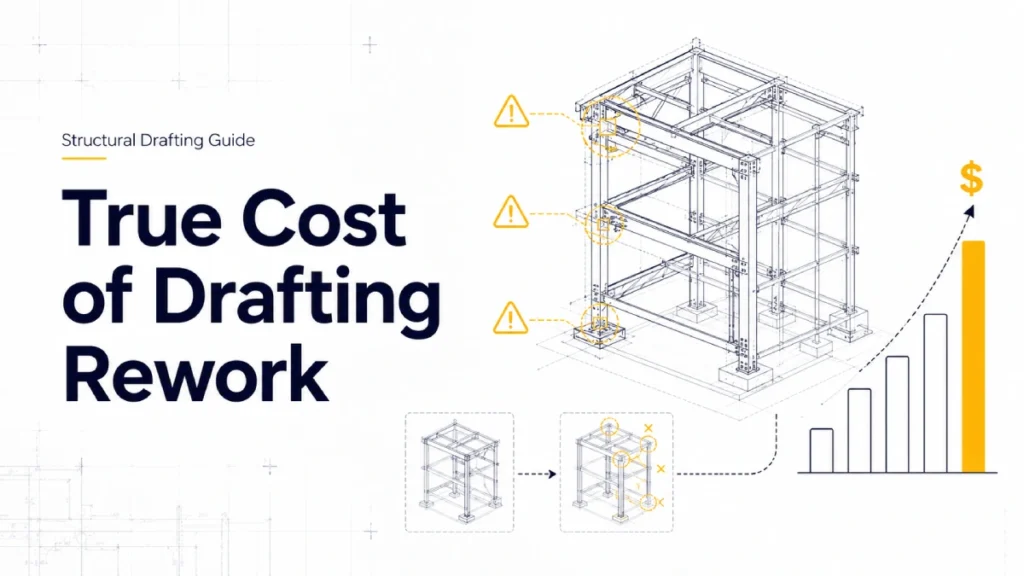
However, corporate ledger lines rarely tell the whole truth. If internal senior engineers burn billable hours fixing uncoordinated files, tracking down broken parametric constraints, or rewriting models to comply with local regional codes, that cheap labor rate disappears. When low-cost drafting deliverables bypass internal check gates and cause direct geometric conflicts or material omissions in the field, the financial consequences are catastrophic.
To protect profitability, firms must move past transactional accounting and evaluate partnerships using a comprehensive operational metric: the Total Cost of Drafting (TCD).
The Total Cost of Drafting (TCD) Equation
Evaluating a technical vendor strictly by their hourly baseline creates an incomplete financial model. To isolate the true operational cost of your engineering supply chain, you must account for internal technical friction, management overhead, and downstream field liabilities.
The baseline mathematical framework for calculating true engineering liability is expressed through the following structural equation:
TCD = (Vh x Hv) + (Eh x He) + Rf
Where,
- Vh (Vendor Hourly Rate): The direct invoice rate billed by your external drafting service provider.
- Hv (Hours Billed by Vendor): The gross number of project hours invoiced by the vendor to complete the initial modeling or detailing sets.
- Eh (Internal Senior Engineer’s Loaded Hourly Rate): The true hourly cost of your domestic senior structural engineers and BIM directors, including baseline salary, benefits, insurance, and corporate overhead.
- He (Internal Friction Hours): The total internal hours spent by your team reviewing, redlining, communicating changes, and manually correcting substandard submissions to bring them up to production-ready status.
- Rf (Cost of Downstream Field Rework): The compounding financial damages incurred if an error or structural detailing omission bypasses the design gate and manifests on the construction site. This includes material disposal, emergency structural modifications, expedited steel re-fabrication, and late-submittal project schedule penalties.
The Internal Friction Multiplier: Industry datasets reveal that for unmanaged, low-tier drafting resources, the internal friction hours (He) routinely equal 40% to 60% of the total project lifecycle duration. A senior engineer earning $120/hour is forced to spend half their week acting as a proofreader, completely wiping out the anticipated financial benefits of labor arbitrage.
The Three Hidden Leakage Points
When a firm treats structural drafting and modeling as a basic commodity, technical debt accumulates across three distinct operational centers:
1. The Senior Engineer Drag
The most widespread vulnerability is the execution of “lazy geometry.” Rushed modelers frequently construct structural elements purely for visual representation in a 2D viewport rather than building accurate structural data integrity. An external drafter might model a critical steel beam-to-column connection as static, unlinked solid shapes instead of utilizing smart components constrained directly to the structural grid. When local teams adjust member sizes, the unlinked geometry fails to update automatically, forcing highly compensated domestic engineers to manually reconstruct the model hierarchy.
2. Regional Building Code Disconnects
A profound operational friction point occurs when remote teams lack a contextual, practical understanding of local structural detailing codes. Global engineering practices are not uniform. While a remote team may possess software proficiency, they frequently falter when applying specialized standards such as ASCE 7 for structural loads or ACI 318 for reinforced concrete design. Common drafting errors include incorrect calculation of rebar lap splice lengths or improper placement of stirrup spacing in high-shear zones.
3. The Time-Zone Communication Penalty
Managing a structural model across multiple time zones requires continuous, synchronized coordination. Without strict data governance, version control inevitably degrades. Remote teams often work on cached, outdated local files or fail to synchronize model modifications in real time, leading to severe element ownership conflicts. When internal teams merge these disconnected files back into the master Common Data Environment (CDE), they encounter broken external references, corrupted families, and untracked spatial changes.
| Cost Metric | Transactional Drafting Vendor | Structurally Governed Partner |
|---|---|---|
| Stated Hourly Base Rate | $22.00 / hour | $30.00 / hour |
| First-Time Quality Pass Rate | 62% High internal revision required | 97.5% ISO 19650-aligned workflow |
| Internal Review Hours Required | 45 Hours / Model Phase | 28 Hours / Model Phase |
| Estimated Internal Review Cost | $5,400.00 45 hours × $120/hour | $3,360.00 28 hours × $120/hour |
| Downstream Field RFI Exposure | 14 RFIs Estimated exposure: 14 × $1,200 = $16,800 | 0–5 RFIs Estimated exposure: $0–$6,000 |
| Estimated Hidden Operational Cost | $22,200.00 $5,400 review cost + $16,800 RFI exposure | $3,360–$9,360 $3,360 review cost + $0–$6,000 RFI exposure |
Transactional vs. Governed Partnership
The true impact of structural drafting quality becomes clear when contrasting a transactional vendor with a structurally governed partner operating under strict BIM Execution Plans (BEP) and ISO 19650 guidelines:
When analyzed through the TCD lens, first-time quality and structural data integrity emerge as the true drivers of profitability. A global partner charging a higher upfront hourly rate who delivers clean, code-compliant, and fully synchronized models ultimately costs your firm thousands of dollars less over the course of a major project lifecycle.
Eliminate Technical Debt Before Construction Begins
Stop losing hard-earned project margins to endless drafting revisions, communication loops, and field rework. Download our comprehensive enterprise whitepaper, “The Hidden Multipliers of Outsourced Structural Drafting,” and discover how to build a bulletproof, zero-defect engineering delivery pipeline.