

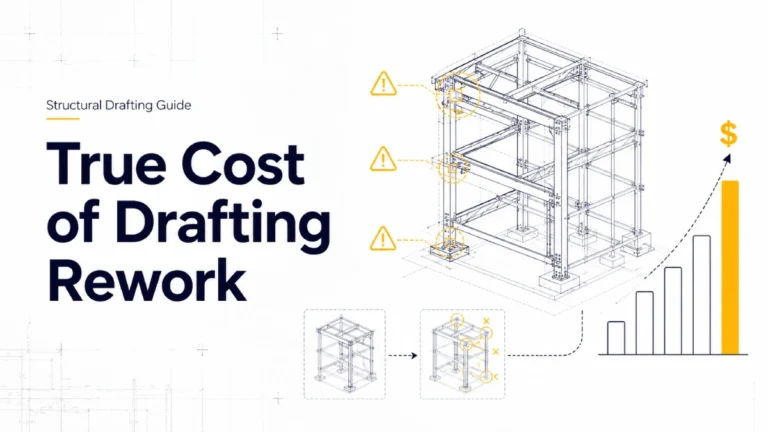

An Operational Framework for Mitigating Technical Debt, Managing BIM Interoperability, and De-Risking Global Engineering Supply Chains
A practical framework for engineering leaders who need to look beyond hourly drafting rates and control the downstream cost of rework, model fragmentation, coordination failures, and weak technical governance.
Thank you. Your download should start automatically. If it does not, use the button below.
Download PDFThe whitepaper introduces the Total Cost of Drafting (TCD) lens: outsourcing savings can disappear when deliverables create internal redesign cycles, code-compliance corrections, BIM interoperability problems, and downstream field rework.
Engineering firms operate under tight margin pressure while local drafting capacity remains difficult to scale. Global technical service providers can expand capacity, but evaluating them only on an hourly-rate basis creates an incomplete operating model.
Technical debt is the future cost of correcting substandard digital assets. Once drafting defects move beyond the digital environment into fabrication or field execution, the cost to correct them can multiply rapidly.
The operational objective is not simply cheaper drafting. It is first-time quality, regional-code alignment, clean model governance, and reliable integration into the master BIM environment.
The paper groups technical debt into three operational failure modes that can undermine model integrity long before a visible field problem appears.
Static, visually correct geometry may fail to behave as an intelligent structural model. When grids or member sizes change, unlinked elements do not update and internal engineers are forced into manual reconstruction.
General software proficiency is not enough when detailing must follow regional standards such as ASCE 7, ACI 318, or Eurocode 2. Code disconnects trigger rejection, correction cycles, and schedule friction.
Weak synchronization, outdated local files, ownership conflicts, broken references, and corrupted families can turn the master model into an unreliable asset and reduce the value of clash detection.
The whitepaper compares the original drafting line-item cost with the downstream financial exposure when errors reach fabrication or the field.
Congestion at beam-column joints can trigger field stoppage, urgent RFIs, and re-fabrication.
Misaligned bolt-hole patterns can create idle crane time, field welding modifications, and structural framing delays.
Structural elements interfering with MEP routing can force multi-discipline revisions and delay sheet sign-off.
The paper argues that a generic BIM Execution Plan is not enough for globally distributed structural drafting. A specialized BEP should act as a binding technical gate with exact constraints and custody rules.
Lock the platform, year, service pack, and hotfix configuration so incompatible model versions or unapproved add-ins do not introduce schema changes or corrupt families.
Define milestone-specific expectations across LOD 200, LOD 300, and LOD 400 so both internal and external teams share the same geometric and information-depth requirements.
Use workset boundaries, ownership schedules, access permissions, and digital checkout protocols to protect the single source of truth.
The governance framework combines manual sampling with automated geometric and metadata checks so quality is verified before downstream coordination begins.
A senior structural engineer samples a defined portion of the package against dimension accuracy, local-code compliance, and annotation clarity.
Predefined rules check hard clashes and clearance clashes before structural assemblies are approved for coordination with architectural or MEP systems.
Automated checks confirm standardized parameters, material properties, manufacturing data, naming conventions, and intact structural-family links.
The complete whitepaper moves from cost exposure to technical controls and then to the operating model required for a governed engineering partnership.
Total Cost of Drafting, margin pressure, rework exposure, and why first-time quality matters.
Model hierarchy, regional code disconnects, and Common Data Environment failures.
The Rework Multiplier and downstream exposure by drafting failure mode.
Software control, LOD boundaries, authorship schedules, and cloud custody.
Sheet sampling, clash-detection protocols, and model-schema verification.
Why governed engineering partnerships can reduce technical debt and preserve digital accountability.
Download the full whitepaper to explore the complete operational framework for mitigating technical debt, strengthening BIM governance, and reducing the downstream risk of outsourced structural drafting.
Our monthly insights for strategic business perspectives.